
EMDR & TRAUMA
Not Broken.
Just Surviving.
Trauma is not a flaw. It is an incredibly ancient and clever mechanism within us. The question is not what is wrong with you, it's what happened to you, and how we help your nervous system finish what it started.

CRPO-Registered Therapists
◦
EMDR-Trained Clinicians
◦
Free 15-Min Consultation
◦
In-Person Appointments in Ontario & NFLD
◦
Online Therapy Across Canada
CRPO-Registered Therapists ◦ EMDR-Trained Clinicians ◦ Free 15-Min Consultation ◦ In-Person Appointments in Ontario & NFLD ◦ Online Therapy Across Canada
UNDERSTANDING TRAUMA
As therapists, we often hear terms like "broken" or "wrong" used by clients to describe themselves or their minds as a result of trauma. But trauma actually has roots in an incredibly ancient and clever mechanism within us.
Picture our ancestors on the savanna. If someone had a close encounter with a predator, the body had to react faster than conscious thought, imprinting the threat immediately and intensely. That same system still lives in us today.
Your Nervous System Was Trying to Protect You
"The challenge is that our modern threats are different. They're often not wolves and lions, but emotional injuries, shaming, neglect, loss, or abuse. Our nervous system doesn't know the difference."
Part of our work together is helping that survival system update its story. We don't want to erase the wisdom. We want to help it realize that what happened in the past may have been awful, but that was then, this is now, and this is safe.
THE NEUROSCIENCE: EMDR is well-researched and recommended by organizations such as the World Health Organization (WHO) and American Psychological Association (APA) for trauma treatment. At Elephant Eye, we integrate grounding, mindfulness, and parts work to ensure sessions remain contained and supportive.
How Trauma Gets Stored & Why It Stays
01
Something overwhelming happens
The brain's alarm system fires. The body floods with stress hormones. Processing shuts down to prioritize survival.
02
The memory gets stored incompletely
Without full processing, the memory is stored with its original emotions, sensations, and beliefs still intact, frozen in time.
03
Triggers bring it into the present
A tone of voice, a smell, a sensation, and the nervous system responds as if the threat is happening now. This is not overreaction. It's the system doing its job.
04
EMDR helps the brain finish the job
Bilateral stimulation activates the brain's natural information processing system, allowing the memory to be fully processed and filed as the past.
05
The charge dissolves
Old experiences lose their emotional intensity and integrate into a healthier story of self. You still remember, but it no longer runs you.
Eye Movement Desensitization and Reprocessing
WHAT IS EMDR?
EMDR is an evidence-based psychotherapeutic approach that helps people process distressing memories, emotions, and beliefs stored in the nervous system. Through guided bilateral stimulation, eye movements, tapping, or tones, the brain's natural healing process resumes.
Unlike traditional talk therapy, EMDR doesn't require you to re-tell your story in detail or analyze why you feel the way you do. The body has its own way of remembering, and we honour that by listening to it, not just your words.
EMDR was developed in 1987 by Francine Shapiro and has since been extensively researched and validated across more than 30 randomized controlled trials. It is recommended for PTSD treatment by the World Health Organization, the American Psychological Association, the UK's NICE guidelines, and dozens of other international health bodies.
At Elephant Eye Therapy, all EMDR sessions are led by therapists with advanced EMDR training and ongoing clinical supervision, ensuring you receive care that meets the highest clinical standard.
Breaking Down the Acronym
E
EYE MOVEMENT
Bilateral stimulation, guided eye movements, tapping, or auditory tones, activates the brain's natural information processing system.
MOVEMENT
The bilateral, rhythmic nature of the stimulation is what distinguishes EMDR from other trauma approaches. It mimics the eye movement that occurs naturally during REM sleep, when the brain consolidates and processes experience.
M
D
DESENSITIZATION
The emotional charge attached to a distressing memory gradually reduces until it no longer triggers the same level of distress.
R
REPROCESSING
The memory is fully processed and integrated, filed as past rather than present. A new, more adaptive understanding emerges naturally.
EMDRIA
Internationally certified EMDR therapists complete rigorous training and supervised practice to meet the highest clinical standard
EMDR International Association
30+
randomized controlled trials have validated EMDR's effectiveness for PTSD and related conditions
EMDRIA Research Summary
WHO
World Health Organization recommends EMDR as a first-line treatment for PTSD in adults and children
WHO Guidelines, 2013 & Updated 2022
FOR EVERYONE — INCLUDING CHILDREN
You Don't Have to Explain Everything to Begin Healing
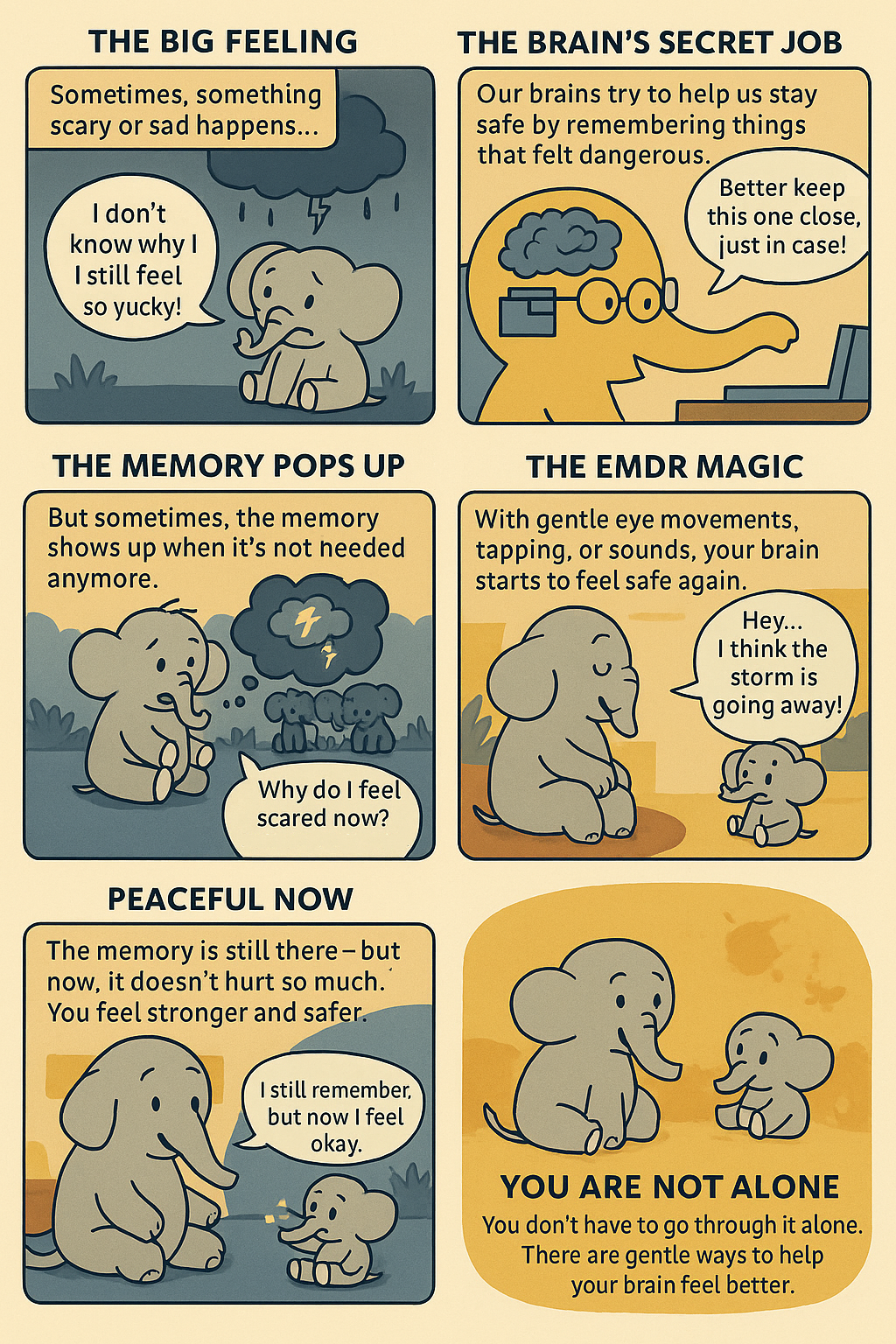
One of the most common fears people bring to EMDR is the belief that they'll have to relive or extensively re-tell what happened. They won't.
EMDR works with the nervous system's own processing capacity, not with the narrative version of events. Your therapist will guide you gently, and you remain fully conscious and in control throughout. You set the pace. You decide what gets touched.
For children, EMDR is adapted with age-appropriate language, imagery, and bilateral stimulation methods that feel more like a game than a clinical procedure. The elephant illustration to the left is one we use to help young clients understand what EMDR is doing, and why they don't have to be scared of it.
A Note on Safety: EMDR is not hypnotherapy and does not involve suggestion or loss of control. At Elephant Eye, we integrate grounding, mindfulness, and parts work throughout EMDR treatment to ensure sessions remain contained, safe, and supportive at every stage.
What Happens in EMDR — The Eight Phases
THE PROCESS
1 - 2
History & Preparation
Your therapist learns your history, identifies targets for processing, and builds the coping resources you'll need before any processing begins. You don't rush this.
3
Assessment
Together you identify a specific memory, the image, belief, emotion, and body sensation associated with it, and measure the current level of distress.
4 - 7
Bilateral stimulation begins. The memory is processed, its emotional charge reduces, and a new positive belief is strengthened and installed in its place.
Processing & Installation
8
Each session closes with grounding. The following session begins with re-evaluation, checking what shifted, what remains, and where to go next.
Closure & Re-Evaluation
COMMON QUESTIONS
EMDR — What People Most Often Ask
-
No. EMDR is designed to help you process memories without being overwhelmed by them. Your therapist will work carefully to ensure you feel safe and grounded throughout. You remain in control of the pace at every stage.
-
It depends on the person and the nature of what's being processed. Single-incident trauma often responds within 6–12 sessions. Complex or developmental trauma typically requires longer, more gradual work. Your therapist will give you a clearer sense after the initial assessment sessions.
-
No. You remain fully conscious and in control throughout every EMDR session. Unlike hypnotherapy, there is no suggestion, altered state, or loss of awareness. You are an active participant, not a passive recipient.
-
Yes — and very effectively. All of our EMDR sessions are delivered virtually using secure, PHIPA-compliant video software with built-in bilateral stimulation tools. Many clients find the comfort of their own environment actually supports the process.
-
Yes. EMDR is well-researched and recommended by the WHO and APA. At Elephant Eye, we take a preparation-first approach, ensuring you have adequate coping resources and a solid therapeutic relationship in place before any trauma processing begins.
-
Gentle and rhythmic. In online sessions, this typically involves following a moving dot on your screen with your eyes, or using tapping (alternately on your knees or hands). Most people find it calming rather than jarring.
-
Yes. EMDR works with sensations, emotions, and body responses, not just explicit memories. You don't need a clear, detailed recollection for processing to happen. Many clients with fragmented or body-held trauma respond well to EMDR.
-
Every therapist on our team holds advanced training and participates in ongoing clinical supervision. EMDR isn't one tool among many for us, it's the foundation of our practice. We also integrate somatic, parts-based, and mindfulness approaches to support the process.
Curious Whether EMDR Might Be Right for You?
READY TO LEARN MORE
A free 15-minute consultation is the best way to find out.
No commitment, no cost — just a conversation with someone who understands the work.